Name

Chemical composition
Colour

Crystal shape
Calcites can form hundreds of different crystal shapes.
They are true shape magicians.
Double spar is particularly impressive.
It is transparent, clear and has the shape of a rhombohedron.
If you look through it, you can see everything twice!
The scalenohedron is also a special crystal shape
that is somewhat reminiscent of a jelly bag cap.

Mohs scale hardness

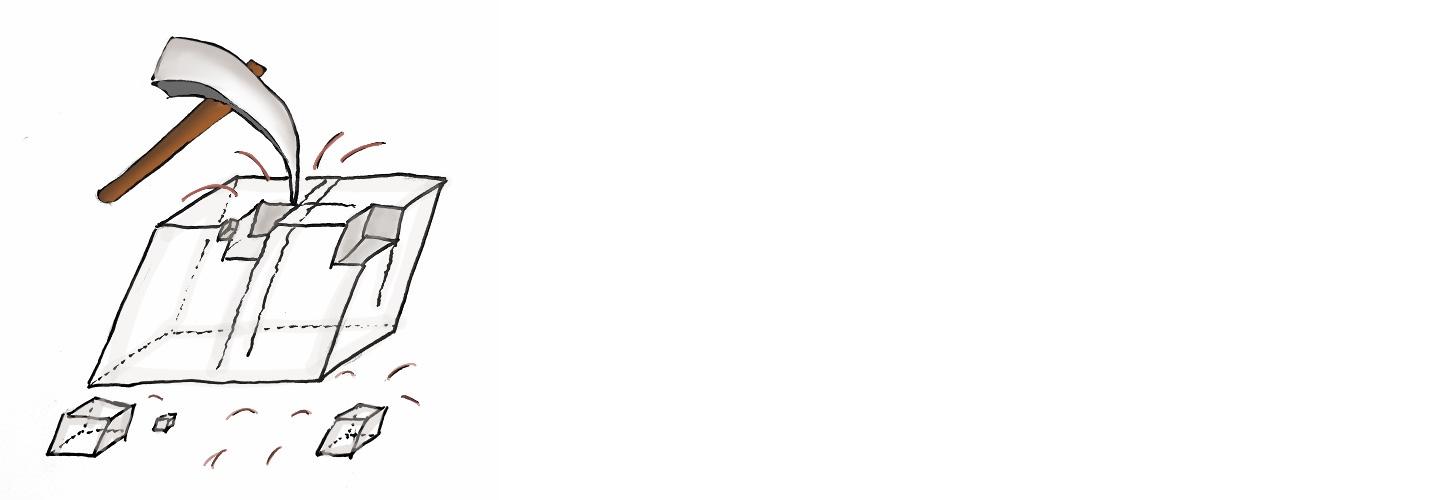
Cleavage and Fracture
Deposites
Calcite is a continuous mineral.
This means that it is very common and
occurs all over the world.
You will often find it together with the minerals
Quartz, fluorite (fluorspar), barite (barite),
galena (galena), sphalerite (zinc blende)
or pyrite (fool's gold).
Calcite is also a component of rocks such as marble or limestone.

Usage
Calcite is a very important raw material because
it is needed in the production of gypsum and cement.
Fertilisers can also be made from calcite.
The effect of birefringence
is particularly important for lenses.
This can be used to build polarisation microscopes
in order to examine the composition of rocks even more closely.

Stroke color
Calcite can come in any color, but its streak is always white. How do you determine this? You need a streak plate for this. It is a small, unglazed porcelain tile with a rough surface. When you draw a line on it with a mineral, the streak color becomes visible; the act of drawing creates a fine powder of the mineral. This identification method is frequently used in mineralogy to distinguish between similar minerals. If a mineral varies in color but its streak remains the same, the mineral is said to be allochromatic (colored by impurities). Calcite is a prime example of this.
Density
A mineral's density influences how heavy it is. This is best illustrated by comparing two identical candy jars: one contains three pieces of candy, while the other holds 100. Which one is heavier? That’s right—the jar with the 100 pieces of candy. It has a higher density, even though both jars look the same from the outside. The same applies to minerals: the higher the density, the heavier the mineral. Calcite has a density of 2.71 g/cm³.
Solubility
Calcite can be dissolved in various liquids. It dissolves very well in hydrochloric acid; even a single drop causes the calcite to foam. In water, however, calcite dissolves only very, very slowly. Stalactites and stalagmites are good examples of this; the calcite is dissolved in the water and slowly crystallizes out with each drop. These formations grow by only 0.1 to 0.3 mm per year. It takes thousands of years for one to grow to a substantial size!